
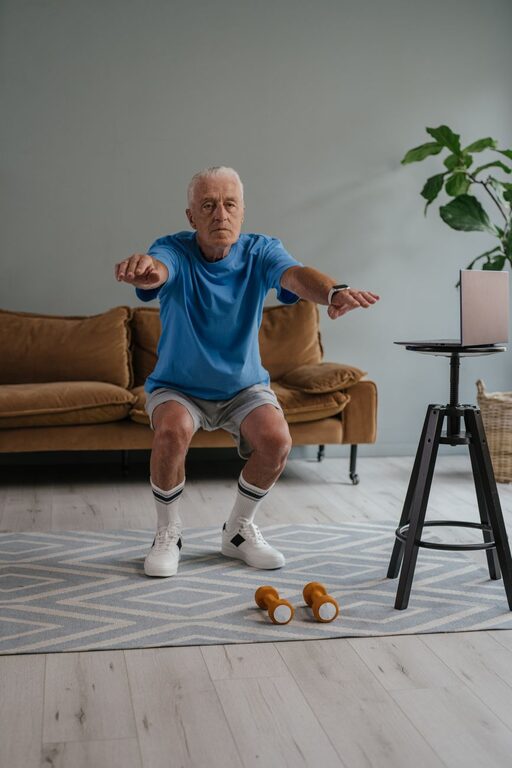
Why Strength Matters for Everyday Mobility
Everyday movement depends on more than flexibility. Strength helps you stand from a chair, climb stairs, carry groceries, reach overhead, and stay steady while changing direction. After 50, a simple strength routine can support these activities and make movement feel more controlled.
You do not need complicated equipment or long workouts. The exercises below focus on common movement patterns and can be adjusted to match your current fitness level. Start slowly, use smooth movements, and focus on good form rather than speed.
Before You Begin
Wear comfortable clothing and choose a clear, well-lit space. Keep a sturdy chair, countertop, or wall nearby for support when needed. Begin with five minutes of easy movement, such as walking around the room, marching gently in place, or moving your shoulders and ankles.
A little muscle effort is normal, but stop if you feel sharp pain, dizziness, chest discomfort, or unusual shortness of breath. If you have an injury, a health condition, or concerns about balance, consider asking a qualified exercise professional for guidance before starting a new routine.
Aim for two or three strength sessions per week, with at least one rest day between sessions. Start with one set of each exercise and gradually work toward two or three sets.
1. Sit to Stand
This exercise trains the legs and hips for one of the most common daily movements: getting up from a chair.
How to do it
- Place a sturdy chair against a wall.
- Sit near the front of the chair with your feet about hip-width apart.
- Lean forward slightly, keeping your back long.
- Press through your feet to stand.
- Pause briefly, then slowly lower yourself back to the chair.
Try 8 to 12 repetitions. Use your hands on the chair or your thighs for light assistance if needed. As you become stronger, cross your arms over your chest or pause just above the seat before standing again.
2. Wall Push Ups
Wall push-ups strengthen the chest, shoulders, and arms while also encouraging steady control through the upper body.
How to do it
- Stand facing a wall, about an arm’s length away.
- Place your hands on the wall at chest height.
- Keep your body in a straight line from head to heels.
- Bend your elbows to bring your chest toward the wall.
- Press through your hands to return to the starting position.
Complete 8 to 12 repetitions. To make the exercise easier, stand closer to the wall. To increase the challenge, step your feet slightly farther back while maintaining good control.
3. Supported Step Ups
Step-ups train the legs and hips for stairs, curbs, and getting in and out of different spaces. Use a low step at first, and keep a railing or sturdy support nearby.
How to do it
- Stand facing a low step with your feet hip-width apart.
- Place one foot fully on the step.
- Press through that foot to bring the other foot up.
- Step down carefully, leading with the same foot.
- Repeat on the other side.
Perform 6 to 10 repetitions per leg. Keep the movement slow and make sure your whole foot stays on the step. If your balance feels uncertain, use a lower surface or practice stepping up and down while holding a secure rail.
4. Hip Hinge
The hip hinge teaches you to bend from the hips while keeping your back in a comfortable, supported position. This pattern is useful when picking up light objects or reaching toward the floor.
How to do it
- Stand with your feet about hip-width apart and your knees slightly bent.
- Place your hands on your hips or across your chest.
- Push your hips gently backward as your upper body leans forward.
- Keep your back long and your weight balanced over your feet.
- Press through your feet and squeeze your hips gently to return upright.
Practice 8 to 12 repetitions. Imagine that you are closing a car door with your hips. Avoid rounding your back or lowering farther than you can control.
5. Calf Raises
Strong calf muscles support walking, stepping, and pushing off the ground. Calf raises are simple to perform and can be done while holding a countertop.
How to do it
- Stand behind a sturdy chair or face a countertop.
- Place your hands lightly on the support.
- Rise onto the balls of your feet.
- Pause at the top.
- Lower your heels slowly to the floor.
Try 10 to 15 repetitions. Keep your weight balanced between both feet. For a greater challenge, pause for two seconds at the top or lower for a count of three.
6. Resistance Band Row
A band row works the upper back and helps practice the pulling motion used when opening doors or moving light objects.
How to do it
- Secure a resistance band around a sturdy post or closed door anchor at about chest height.
- Hold one end in each hand and stand far enough away to create light tension.
- Keep your shoulders relaxed and your elbows close to your sides.
- Pull the handles or band ends toward your ribs.
- Pause briefly, then slowly extend your arms.
Complete 8 to 12 repetitions. Keep your wrists straight and avoid shrugging your shoulders. If you do not have a band, practice the same movement by gently squeezing your shoulder blades together without equipment.
7. Farmer Carry
Carrying a light object builds practical strength in the hands, arms, shoulders, and torso. It also encourages upright posture while walking.
How to do it
- Hold a light, evenly weighted object in each hand.
- Stand tall with your shoulders relaxed.
- Walk slowly across the room for 20 to 30 seconds.
- Set the objects down carefully and rest.
- Repeat once or twice.
Use small water bottles or light household items to begin. Keep the weight close to your sides, take short steps, and look ahead rather than down. If carrying two objects feels difficult, use one light object and switch sides.
How to Build a Simple Routine
Choose four or five exercises for each session. For example:
- Sit to stand
- Wall push-ups
- Supported step-ups
- Resistance band rows
- Calf raises
Rest for about 30 to 90 seconds between sets, depending on how you feel. When the exercises become comfortable, add a few repetitions, use slightly more resistance, or increase the number of sets. Change only one factor at a time.
Quality matters more than quantity. Smooth, controlled repetitions help you learn the movement and reduce the temptation to use momentum. Keep breathing steadily rather than holding your breath.
Make Strength Part of Daily Life
Short sessions are easier to maintain than occasional, demanding workouts. You might exercise after a morning walk, before lunch, or while waiting for water to boil. Everyday choices can also add useful movement: stand during phone calls, take an extra trip when carrying light items, or practice one set of sit-to-stands during a television break.
The goal is not to move perfectly or lift heavy loads. It is to build dependable strength that supports walking, standing, reaching, and carrying. With regular practice and gradual progress, these simple exercises can become a practical part of an active lifestyle after 50.
About the Author